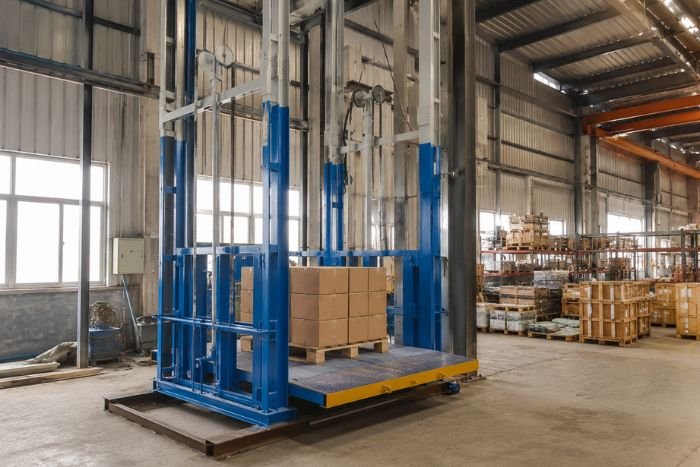
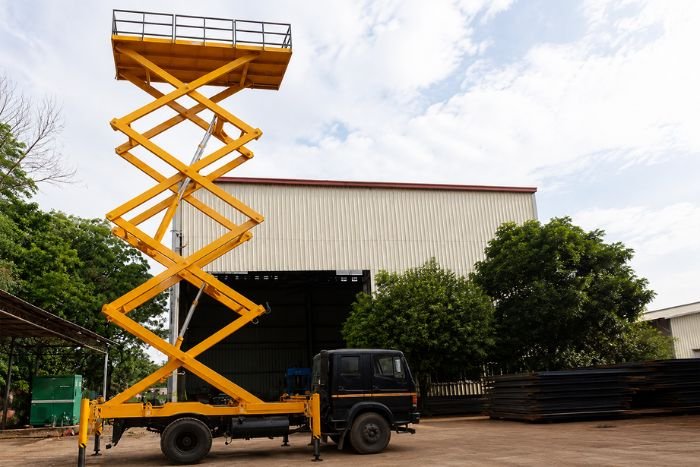
In modern industries, moving heavy materials and providing safe access to elevated work areas are important parts of everyday operations. A scissor lift offers a practical solution for lifting materials, equipment, and personnel to the required working height. From manufacturing plants and warehouses to assembly lines and maintenance facilities, scissor lifts can improve productivity while reducing manual material handling.
However, choosing the right industrial scissor lift requires more than simply checking its lifting height. Load capacity, platform dimensions, installation type, working environment, safety features, power supply, and customization requirements should all be considered.
For businesses searching for reliable scissor lift manufacturers in Coimbatore, Isha Engineering and Co. provides standard and customized hydraulic lifting solutions for different industrial applications. The company manufactures multiple scissor lift configurations, including high-rise, heavy-duty, pit-mounted, industrial, low-closed-height and floor-mounted models.
What Is an Industrial Scissor Lift?
An industrial scissor lift is a lifting platform designed to move vertically using a crossed scissor mechanism. Hydraulic systems are commonly used to raise and lower the platform smoothly.
Unlike conventional lifting methods that may require more manual effort, a hydraulic scissor lift can provide controlled vertical movement for production, assembly, loading, maintenance and material-handling operations.
Depending on the application, businesses can choose stationary, movable, pit-mounted, floor-mounted, high-rise or customized scissor lifts.
1. Determine the Required Load Capacity
Load capacity is one of the first factors to consider when choosing a scissor lift.
Before selecting a model, calculate the maximum weight the platform will need to carry. This should include materials, tools, machinery and other loads that may be placed on the platform during operation.
A lift designed for lighter loads may not be suitable for heavy manufacturing applications. Likewise, choosing significantly more capacity than required may unnecessarily increase the size and cost of the equipment.
Isha Engineering also manufactures customized scissor lifts for specific industrial requirements. For example, its scissor lift solution for valve assembly is available with capacities of up to 40 tonnes and lifting heights of up to 10 metres, with customizable platform dimensions.
2. Consider the Required Lifting Height
The next important consideration is lifting height.
Ask where the platform needs to reach during normal operations. A warehouse may require movement between different loading levels, while a manufacturing facility may need a lift table positioned at a comfortable assembly height.
Choosing the correct lifting range helps the equipment perform its intended task without unnecessarily increasing machine dimensions.
For applications involving greater vertical movement, a high-rise scissor lift may be appropriate. For production and assembly operations with moderate lifting requirements, a standard industrial or floor-mounted model may provide a better solution.
3. Choose the Correct Platform Size
Platform dimensions should match the materials or equipment being handled.
An undersized platform can make material positioning difficult, while an excessively large platform can occupy unnecessary floor space. Consider the length, width and shape of the materials that will regularly be placed on the lift.
Customization becomes particularly useful when handling machinery components, pallets or oversized industrial products.
For example, Isha Engineering’s floor-mounted scissor lifts can be configured for substantial platform dimensions depending on the application, demonstrating why platform size should be selected according to actual operational requirements rather than using a one-size-fits-all approach.
4. Pit-Mounted vs Floor-Mounted Scissor Lift
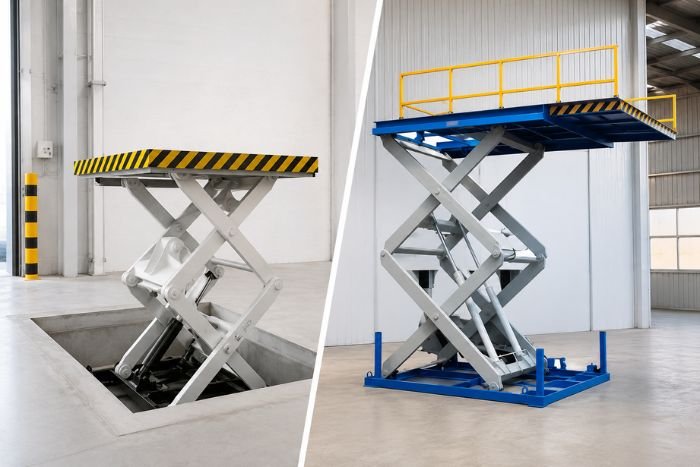
Installation type is another major decision.
A pit-mounted scissor lift is installed within a prepared pit so that the platform can remain closer to or level with the surrounding floor when fully lowered. This arrangement can be useful for loading and material movement where easy platform access is important.
A floor-mounted scissor lift, on the other hand, is installed directly on the existing floor. It can be suitable when creating a pit is difficult or when the facility requires a simpler installation arrangement.
Isha Engineering’s floor-mounted models are designed for applications such as shop floors, assembly lines and production lines. Low-profile configurations are also available for applications requiring a lower platform position.
5. Understand Your Industrial Application
Different industries use scissor lifts for different purposes. Before purchasing one, clearly define what the equipment will do every day.
Typical applications include:
- Production and assembly lines
- Warehouse material handling
- Machine assembly
- Loading and unloading
- Maintenance activities
- Component positioning
- Moving heavy materials vertically
- Automotive and engineering applications
For repetitive assembly work, a scissor lift can help position components at a practical working level. In material-handling applications, it can reduce repeated manual lifting and improve workflow.
Isha Engineering states that its valve-assembly scissor lift solution is designed to improve production, support faster assembly and reduce manual effort.
6. Check Essential Safety Features
Safety should be a key consideration when selecting any hydraulic scissor lift.
The required safety equipment will depend on the application and installation. Features can include handrails, mechanical locking arrangements, emergency lowering systems, overload protection, limit switches, safety fencing and interlocked gates.
Isha Engineering’s floor-mounted scissor lift options include features such as anti-skid steel platforms, mechanical locks, manual emergency lowering, auto power-failure lowering, limit switches, overload relief and electro-mechanically interlocked gates.
The final safety configuration should always be determined according to the intended use, operating environment and applicable safety requirements.
7. Consider Available Floor Space
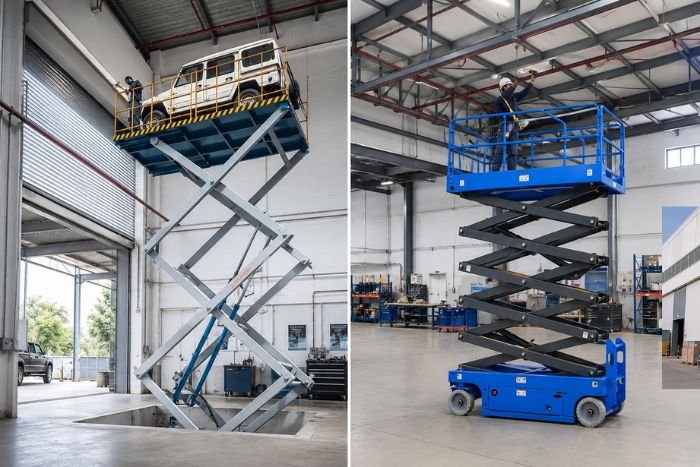
Industrial floor space is valuable.
Before ordering a scissor lift, measure the available installation area carefully. Consider not only the platform dimensions but also surrounding clearance, material movement, operator access and nearby machinery.
Facilities with limited space may benefit from a compact or customized scissor lift. A properly designed system can integrate more effectively into an existing production layout without unnecessarily interrupting workflow.
8. Select the Right Power Source
The available electrical supply at your facility should also be checked before choosing a lift.
Depending on the model and application, hydraulic scissor lifts can operate using single-phase or three-phase power. Isha Engineering lists both single- and three-phase options for its floor-mounted scissor lift range.
Discuss your site’s available power supply with the manufacturer before finalizing the equipment specification.
9. Consider Customization Requirements
Not every industrial application can be handled efficiently with standard lifting equipment.
A customized scissor lift may be necessary when your business requires a specific load capacity, platform dimension, lifting height or installation arrangement.
Customization can be particularly valuable for assembly lines, machine positioning, specialized material handling and facilities where existing layouts restrict the available installation space.
Isha Engineering lists Scissor Lift, Movable Scissor Lift and Customized Scissor Lift among its product offerings, providing options for different industrial requirements.
10. Choose an Experienced Scissor Lift Manufacturer
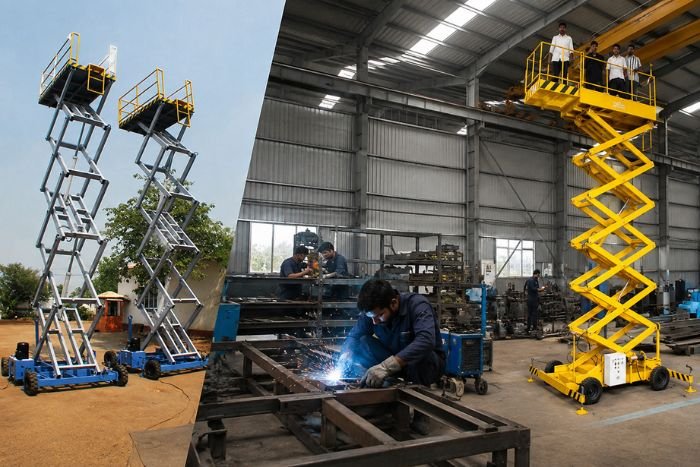
The manufacturer is just as important as the lift specification.
Look for an industrial equipment manufacturer with experience in hydraulic engineering, product customization, design capabilities and installation support.
Isha Engineering and Co. was established in 1993 and manufactures a broad range of hydraulic and material-handling equipment. Its facility includes an in-house design unit using CAD and SOLIDWORKS, along with research and development capabilities for industrial equipment design.
Businesses looking for a scissor lift manufacturer in Coimbatore, Tamil Nadu, can therefore discuss application-specific lifting requirements rather than selecting equipment based only on standard specifications.
Why Choose Isha Engineering for Industrial Scissor Lifts?
Isha Engineering and Co. manufactures hydraulic equipment for a variety of industrial requirements, with scissor lift options ranging from standard industrial models to customized solutions.
Its scissor lift category includes High Rise Scissor Lifts, Heavy Duty Scissor Lifts, Pit Mounted Scissor Lifts, Industrial Scissor Lifts, Low Closed Height Scissor Lifts, Floor Mounted Scissor Lifts, E-Type Platform Lifts, Scissor Lifts for Machine Assembly and Car Parking Scissor Lifts.
With its manufacturing facility and engineering capabilities in Coimbatore, the company can support customers looking for lifting solutions designed around their load, height, platform and application requirements.
Conclusion
Choosing the right scissor lift for industrial needs starts with understanding the application. Load capacity, lifting height, platform dimensions, installation method, available space, power supply, safety requirements and customization should all be evaluated before making a purchase.
A correctly selected hydraulic scissor lift can make material handling easier, support efficient production processes and provide a practical solution for repetitive industrial lifting operations.
If your factory, warehouse, assembly unit or manufacturing facility requires a standard or customized industrial scissor lift, Isha Engineering and Co. can provide hydraulic lifting solutions based on specific operational requirements.